Teaching elementary kids to write an opinion paragraph is sort of tricky and supporting an opinion takes time and practice. I started with my kids back in the fall to instill the structure. Although Thanksgiving is long gone, this writing project The Best Thing on the Thanksgiving Table: Opinion Writing was a great success. It was truly authentic writing and the kids were excited to get started- even my reluctant writers were jazzed to share. I easily met several standards and the skills were taught in context. These pieces got a lot of attention in the hall as well. We have a dedicated writing workshop chunk of time each day so it took us four days to from when I introduced the project to the final drafts hanging in the hall.
Step 1: Get Ideas Flowing. During Morning Meeting we shared a favorite Thanksgiving food and why we liked it so much. I always choose tomato gravy, a sweet, crimson-colored sauce from my childhood. Most kids have never heard of it so it gives me lots of possibilities to model my thinking throughout the project.
Step 2: Model First. how to choose a food and the topic sentence/concluding sentence on a graphic organizer. I modeled tomato gravy knowing no one else would 'take' it and shared the graphic organizer. You can get an opinion organizer HERE and and opinion writing rubric HERE for general projects, but a tailored version is also included in The Best Thing on the Thanksgiving Table. I like to have kids come up with their topic and concluding sentence right after they have selected the food. Introducing an opinion topic sentence needed a bit of work because key is to keep it general. As a group we generated possible topic and concluding sentences I could use on the board. Keep them up. They serve as student inspiration as well. Whenever working on topic/concluding sentences I ALWAYS use the hand-dandy whiteboard manipulatives included in this BUNDLE. Kids need a resource and they use this one! I put both out both sets for differentiation. Students then return to their seats to write their topic and concluding sentences. My heart sings when a child takes a word from the board, uses it at their seat, then returns it.
Step 3: Finish the Plan. The 'meat' of the writing are reasons supporting the opinion. First, we wrote a list of ideas on WHY a food could be a favorite. I'm sure we include how it tastes and what it looks like, but also take a step further tapping into family traditions or memories they have of the food. Look closely at the example to the left. This little friend, a reluctant writer, did an amazing job. Again, model your plan before letting kids complete their graphic organizer and differentiate as needed. Some may push themselves to write just two reasons while others 'dig deeper' and explaining their ideas more fully.
Step 4: Draft. I project my organizer then demonstrate how I used my plan to write an organized draft. We use plain lined notebook paper and skip lines. For this particular project I used the included Thanksgiving Word Bank to hold kids accountable for spelling. Depending on your grade level we read the list in unison before writing so everyone knows the words.
Step 5: Edit. Self edit. Peer edit. Teacher edit. 'Nuff said. We don't catch every single mistake prior to posting in the hall, however, the process is what is important.
Step 6. Final Draft. I like to have several versions of final draft paper for kids to choose from. Room for illustrations are a great touch.
Here are some other projects that get kids excited about writing!
Halloween Candy Opinion Writing
The Ultimate Birthday Party Description Writing
A Time I Got Hurt Personal Narrative
How to Make My Paper Snowflake
Book Recommendation
March 22, 2017
6 Steps to Writing Great Opinion Paragraphs
February 26, 2017
Student Guest Reader
Meet Sam. Sam was my Guest Reader last week. He read The Amazing Bone by William Steig to our class. He read it fluently, added in voices for the characters and did not stumble on some pretty sophisticated vocabulary. My cuties were a fantastic audience and when Sam was done with the story they all clapped.
Several years ago Sam was MY student - and he really struggled with reading. He tried SO hard. I gave that boy extra time, lessons and attention. His parents worked with him every night. Although he wanted to unlock the reading magic so badly, it hadn't clicked for him - yet.
Sometimes kids simply need more time than others. Sam is now, several years later, a Harry Potter enthusiast, one of the top readers in his grade and a solid student. He stops by my room a couple of days a week before heading home to chat. He talks about the books he's reading and what's going on in his life. Isn't witnessing this kind of academic growth and making a real friendship connection with a child what teaching is all about?
Do you have guest readers? I always have. Usually it is a student's parent or grandparent who comes in at the end of the day and shares a book. Sam remembered this - and asked if HE could be a guest reader sometime. We picked out a book, he took it home, practiced on his younger sibling and the next day said he was ready. Why had I not thought of this before?? Inviting a student to guest read was a win-win experience.
It was a win for my class - Many recognized him from seeing him in the hall or when he dropped by before heading home and felt like a friend was reading to them. They got to watch a kid, not much older, be a great reader. It was new and different. It was a win for Sam - he took on a leadership role and walked away with a great sense of satisfaction. Recalling his struggle many years ago, I took a video and some pics and sent them to his mom. The smile on his face when he was finished was priceless. You may want to invite a student guest reader too!
November 23, 2016
Reinforcing Genre with Book Club Flyers
Throughout the year I've maintained a genre wall. We talk about genre all the time during the daily read aloud and mini lesson. It feels at times, however, no matter how many times I've refer to our wall chart, it doesn't sink in well. While most can identify fiction vs. non-fiction, picking apart different sorts of fiction can be tricky.
On the day before break I had a roomful of antsy kids. What do to to keep them engaged and learning? I pulled out my book order stash and integrated them into my literacy block. I want to see how well they could identify genre on their own. I explained their three options prior to letting them loose cutting, sorting and gluing:

Giving kids the freedom to create their own book sort allowed them to 'buy into' the project. The kids took all sorts of approaches for the 'create your own genre sort' option. One was Harry Potter vs. other chapter books I'd consider reading....
It allowed for differentiation, collaboration and independent thought.
No matter the genre they chose, regardless of their reading level and confidence - those cuties were actively talking about books. There were so many teachable moments that arose. Book blurbs aren't just for the back of books. Kevin Henkes wrote that too?! Is the Who Would Win series fiction or non-fiction? During the 30 minute activity I was easily able support both those struggling with the basic concept of fiction vs. non-fiction and those who pushed themselves to go beyond. I referred to my genre bulletin board over and over when kids had questions. It was also great to see kids using it independently and talking to friends about the genre of a specific book.
I also love bringing out book orders during my math block:
We round prices, estimate the total of a wish list, put books in order according to price, add prices, subtract items. It's fun, engaging and real world thinking.
Book club flyers arrive in my mailbox on a fairly regular basis. I don't send home the orders as often as I once did, but they remain a valuable resource for incorporating real life skills in the classroom. On occasion I'll pick up additional grade level or focus flyers from the community table so I have a variety of flyers on hand.
Yes, the room was a disaster when we were finished but it was engaging and worthwhile. The clean up was quick and we got through the afternoon prior to a break with authentic learning in place.
October 18, 2016
6 Ways to Support Beginning Researchers
Just in time for Halloween, my students researched bats last week. This is our first research project of the year - there are more to come - and the kids loved doing it! Overall I'm pleased with our first formal research efforts and I'd love to pass along ideas I incorporated making the process smooth with built in success for beginning researchers.
1. Model every aspect of what you expect students to do. Don't assume they know! For this bat research I declared vampire bats off limits because I used it for my research example. When our Scholastic News packet came in a few weeks ago I was so pleased. They had an entire edition on vampire bats! I pulled some book resources and two days before assigning research groups I demonstrated how to collect vampire bat facts. I showed the kids how to safely Google for additional information and how to record their resources. At each stage it is critical to explain what you are looking for, and how to be organized. After students collected their information I modeled how to thoughtfully create a vampire bat brochure so they could see the quality and elements I look for.
2. Have beginning researchers work in groups. I posted a list of different bats and asked each child to write their top three choices. Using their requests (gotta have buy in!), their reading level and what I know about their personalities I was able to make groups of 2 or 3 students. It was a thoughtful process and I was sure the group combinations supported my low readers and pushed my high achievers as well. I ensured my IEP students collaborated with the special ed team and my identified Talented and Gifted worked with the most advanced resources.3. Collect resources prior to research. I wanted my students to use both print and online resources. This meant raiding our school and public library for bat books. I kept them all in one bin and did NOT allow students to put any of them in their Book Bins. It meant Googling different bats to see which ones had the most information at my students' reading levels. Based on the resources available and student needs I tailored the bat choice list.
4. Ask parents to come and help when kids are doing the research. I collaborate with my Technology Teacher when kids have done research before, however, I get as many adult helpers in the room as I can during the fact collection process. The adult helpers listen to my instructions then circulate, troubleshoot, assist and encourage all the groups. Whew! I would have a massive headache if it were just me in that room with all those hands up!
5. Expect kids create their own end product. Although students may be working from the same collection of facts as their research teammates, expect each kid to create their own end product. It was easy differentiate and see where some students need reteaching. 6. When finished, show kids the rubric. Discuss how the class, as a group, would score the vampire bat research model. After that allow kids to review and revise their own brochure to get the score desired. Allow kids to reflect on the process too. Beginning researchers may need a bit of coaching on this piece but it give you valuable insight.
Looking for other great research project for your class? Click on the links below. All are appropriate for both the seasoned and beginning researcher!
National Park Research Project
U.S. Landmark Research Project
Native American Tribe Research Project
Country Research Project
State Research Project
Explorer Research Project
Planet Research Project
Penguin Research Project
President Research Project
October 2, 2016
Read to Self Anchor Chart
.
This is a quick follow up post to this one. Voila! It's my Read to Self anchor chart complete with photos of my students doing Read to Self the way I have trained them.
While the kids are practicing their stamina I get out my cell phone and take photos of what Read to Self looks like. I have yet to figure out the way to turn the sound off when I snap the picture. Unfortunately that can cause them to look at me. No worries - I just do the quiet signal and they get back to the task. Kids love to see themselves 'in action' and it is a super easy way to reinforce expectations.
September 25, 2016
Introducing and Reinforcing Read to Self
No matter how many other tasks I'm required to do the first week of school, I make introducing Read to Self a priority. I want to get the process started early and begin establishing expectations. Plus, those kids need to get reading! I use end of year testing data to get a sense of each students' reading level and prior to the start of school I phone each of my new families to find out what sort of books those kids like. Using all that info, I become a personal librarian and populate each student's book bin with books I feel will be a good fit. Building stamina begins on day 1!
I have yet to find a better explanation outside of the Daily 5 book to introduce Read to Self. I follow The Sisters process closely. My kids' favorite part is being a "star" in the example/non-example process! I make an anchor chart and put it on the wall. Prior to each session we go over expectations. Many kids have not had so much freedom selecting where and what they'll read. What a treat to watch kids get excited about choosing a book and finding the perfect spot!
This year I have a room full of wiggle worms, therefore I'm spending a bit more time than I have in the past actively monitoring the group while they build stamina. Although it has delayed starting one-on-one conferencing, I feel this is time well spent. Nipping issues and bad habits now will help the rest of the year will go smoothly.
The second week of school I brought out the Read to Self Habit Sort for Lower Elementary (I actually printed out a couple of the Upper Elementary version too for differentiation.) I recently revamped it and am excited about the improvements and additional pieces. In addition to a new font, it also includes a second page with the same habits but in a larger font for wall anchor charts or on a whiteboard. I expect my students to recreate the sort in their Reader's Notebook after we do it whole group. As each element is introduced we do the other sorts included in this BUNDLE
The third week I copied and send home Read to Self Routine Homework! I do love this. The half page includes specific questions for an adult to ask the child about Read to Self. Students get to become the experts at home, further reinforcing expectations. The notes I get back from parents range from "Jace understands what to do." to "Kaelyn has never been so excited about reading before! Thank you!" to "It's good to get a glimpse into the class." The sheets include homework for the other Daily 5 elements as well.
The fourth week things run pretty smoothly. It is at that point I get out my camera and start taking photos of the kids who are doing exactly what I expect. I print the photos and post them around our Read to Self anchor chart. This keeps it fresh and kids are always hoping to have their picture added throughout the year. It's such a simple way to reinforce the habits and recognize children at any reading level loving books. One piece of advice - kids start to ham it up when they see a camera. If a child suddenly changes what they were doing to smile, I whisper "I take photos of kids who are working hard." then circle back.
Ironically, one of the favorite photos I've taken for this purpose was of a girl with a furrowed brow and a down-turned mouth. She was leaning her head in her hand, her book just inches from her face. When I posted that one, the girl called out, "That is a terrible picture of me!"
"What book are you reading now?"
"Sadako and the Thousand Paper Cranes"
"What was going on in the story when we did Read to Self today?"
"Sadako is very sick. They had to put her in the hospital."
"Did you know I took this photo?"
She shook her head no.
"That is why I wanted to show it. Your worry for the main character is on your face. You know how scared you are by the way you hold your head. You didn't know I was right next to you because you were so focused on Sadako's story. This is what being lost in a book looks like! I LOVE this picture!"
I just about started to cry when all the other kids cheered for her.....
Labels:
Back to School,
Daily 5,
Organization,
Reading Workshop
September 18, 2016
Popcorn Fun!
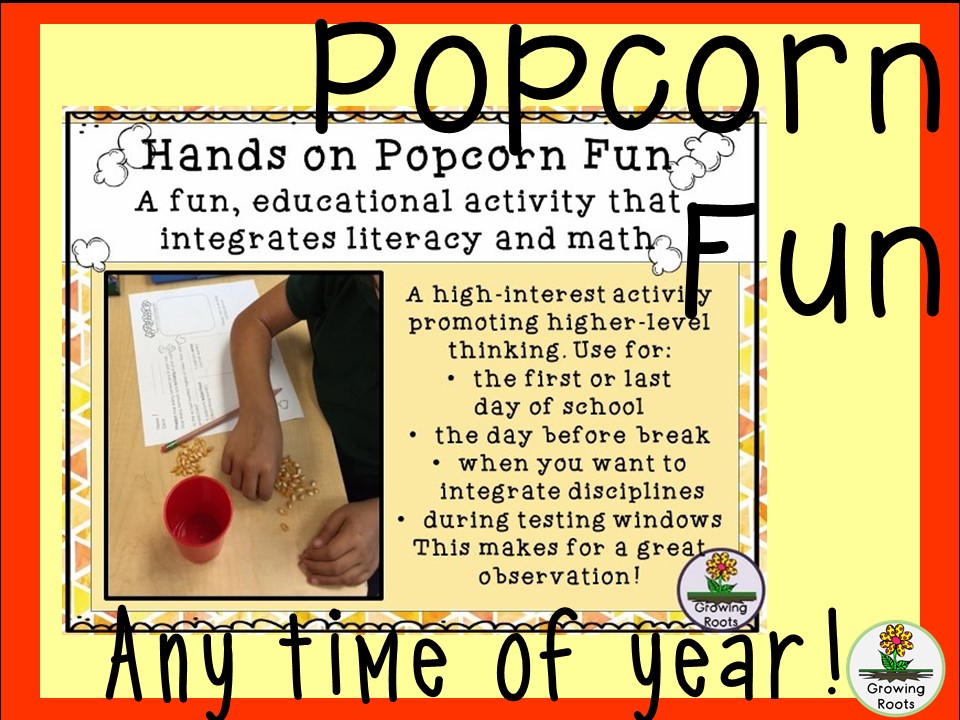
Due to a miscommunication I found myself with 40 minutes of unscheduled time the other day. Opps! I pulled out one of my favorite cross-curricular activities, Popcorn Fun: A Hands-on, Integrated Learning Activity, and saved the day! I've used this resource for years and it's always a hit with the elementary crowd. I make copies to have on hand at the beginning of the year for occasions such as this.
In order to be prepared I keep a 99 cent bag of popcorn in my cupboard. I'd be scared to tally up how many times the popcorn in that bag has been handled, drawn and counted by my students.
There are several reasons why this unit is a hit with kids. First, everyone has an opinion about popcorn - and most kids like it. Second, there are no wrong answers. Third, kids get excited to learn new facts about something they are really familiar with from both book and video resources. Teachers like this unit too! Kids are actively engaged and and there is a lot of sneaky learning that goes on -- how to take notes, generating parts of speech, non-fiction text features and math. Popcorn Fun can be completed in an afternoon (fine for older kids) or divided into smaller chunks (better for younger kids). Each year is a little different but this is how the lesson went this year...
Day 1 1:00 - Panic!! The art teacher left early. I've got the kids for 40 mins. What am I going to do? Deep breath. Calm. Get out Popcorn Fun papers.
1:05 - Gather in a group and discuss the variety of ways to prepare popcorn. Make a list of background knowledge facts. Students record their own background knowledge on the paper.
1:15 - Pass out popcorn kernels in cups. Draw diagram. What a great time to discuss labels!
1:30 - Make popcorn kernel predictions. Watch kids count the actual number of kernels in the cup is always fun to watch. Since I do not give instructions on how to do it those kids come up with a variety of problem solving solutions.
1:45 - Back to the regularly scheduled program
Day 2
2:00 Read book about popcorn - as a whole group, we remember new facts we learn from the book. I project a word document to record the facts, modeling note taking skills.
Show video about popcorn - as a whole group, add additional facts to the word document
2:30 - Teach kids how to cite their sources
2:35 - Students choose the facts they find most interesting to write on their paper. Differentiate as needed.
Day 3 - In small groups, complete the popcorn parts of speech sections.
Later in the day, eat Kettle Korn - using the included recipe. Yum!
Popcorn Fun: A Hands-on, Integrated Learning Activity puts many skills and strategies into motion with an authentic experience. Fellow teachers have used this a regular back to school activity and is great for observations. Happy popping!
Subscribe to:
Posts (Atom)